Evidence and honesty
Each piece exists somewhere. No one else connects all of them in one measured network.
We would rather a partner hear the limits from us than discover them. This page is the comparison we make, the evidence we lean on, and the barriers we have not cleared yet.
The comparison
Each piece exists somewhere
Against telehealth marketplaces, faith-based care ministries and peer-support apps. Presence+ has all seven.
Community at the point of care
Telehealth marketplaces: No. Faith-based care ministries: Yes. Peer-support apps: No. Presence+: yes.
A complete model of the person
Telehealth marketplaces: No. Faith-based care ministries: Sometimes. Peer-support apps: No. Presence+: yes.
Trained lay helpers with a growth path
Telehealth marketplaces: No. Faith-based care ministries: Sometimes. Peer-support apps: Sometimes. Presence+: yes.
Licensed care when it is needed
Telehealth marketplaces: Yes. Faith-based care ministries: Rarely. Peer-support apps: Rarely. Presence+: yes.
Outcomes measured every session
Telehealth marketplaces: Rarely. Faith-based care ministries: No. Peer-support apps: Rarely. Presence+: yes.
Emotional and spiritual care together
Telehealth marketplaces: No. Faith-based care ministries: Yes. Peer-support apps: No. Presence+: yes.
A revenue model that sustains itself
Telehealth marketplaces: Yes. Faith-based care ministries: No. Peer-support apps: Yes. Presence+: yes.
Barriers we have to clear
What could stop this, and what we are doing about each
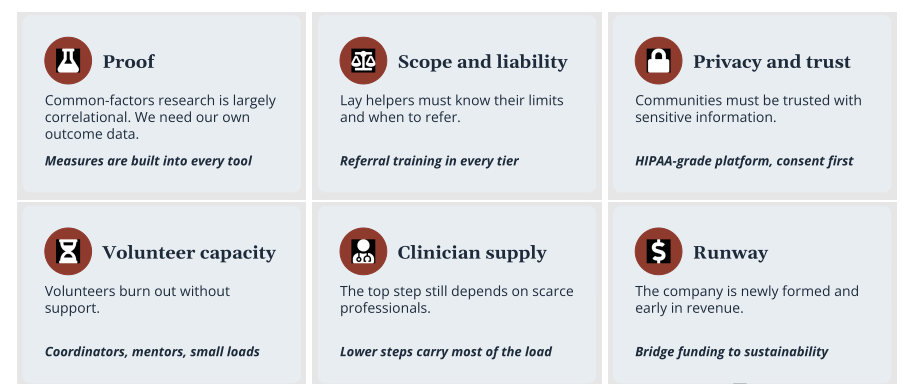
Proof
Common-factors research is largely correlational, so we need our own outcome data. The measures are built into every tool, and we will publish results across every level.
Scope and liability
Lay helpers must know their limits and when to refer. Referral training is in every tier, every helper discloses scope early and often, and each works under the leadership of their own community.
Privacy and trust
Communities must be trusted with sensitive information. The record sits in the Presence+ data store, HIPAA-grade, with consent first; nothing moves between a community and a clinician without the person's say, and the person, the helper and the community's leaders each set the sharing policy for their part.
Volunteer capacity
Volunteers burn out without support. So: coordinators, mentors, small loads.
Clinician supply
The top step still depends on scarce professionals. The lower steps carry most of the load.
Runway
The network is early in revenue. Bridge funding carries it to the point where paid helpers and partners fund the sponsored tier.
What we are trying to achieve
Four targets we will report against
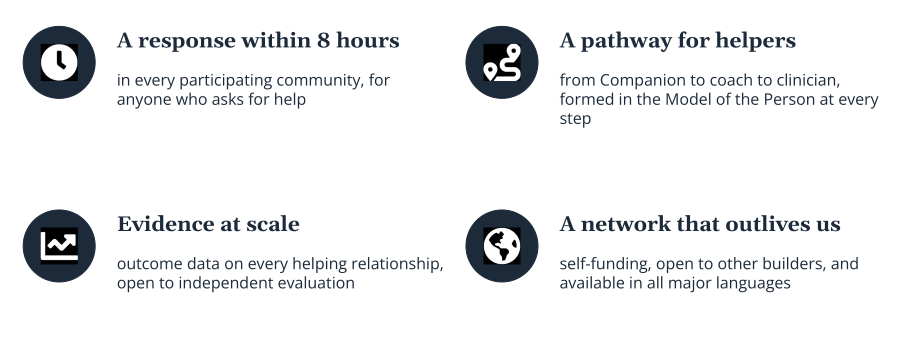
A response within eight hours in every participating community, for anyone who asks for help. A pathway for helpers from Companion to coach to clinician, formed in the Model of the Person at every step. Outcome data on every helping relationship, open to independent evaluation. A network that outlives us: self-funding, open to other builders, and available in the major languages.
Fund an independent evaluation
We are looking for an outside research partner to test whether accompaniment through STEP improves outcomes, and for funders willing to pay for the answer either way.