The research
How help works, and why that lets ordinary people give it.
Four decades of psychotherapy research point the same way: what heals is a real relationship, a credible explanation the person accepts, and healthier action in daily life. Those are qualities of a relationship, not a technique. They can be taught, practiced and measured.
Wampold's contextual model
Three pathways to change
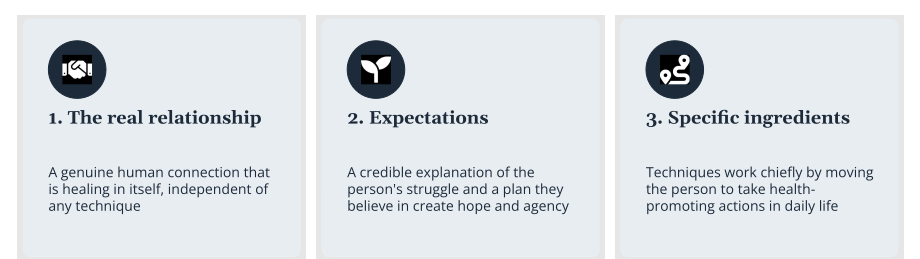
All three pathways can be offered by a trained helper inside a community, where the Model of the Person gives helpers a shared account of the person and of healing.
Wampold (2015), World Psychiatry 14(3); Wampold & Imel (2015); Frank & Frank (1991), Persuasion and Healing.
The relationship
The alliance strongly predicts outcome
Across the 2018 Psychotherapy special issue on relationships that work, the alliance, empathy, goal consensus, positive regard and congruence each predicted outcome. Differences between treatment methods are small by comparison. Who the helper is, and how they relate, matters more.
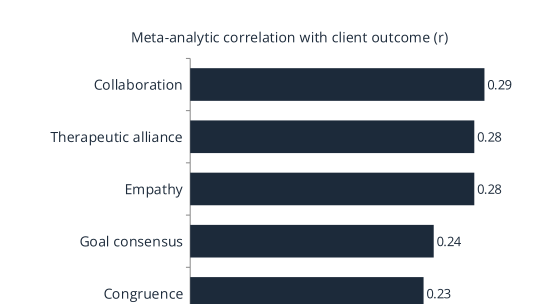
Psychotherapy 55(4), 2018: Tryon et al.; Flückiger et al.; Elliott et al.; Kolden et al.; Constantino et al. See also Norcross & Lambert (2019).
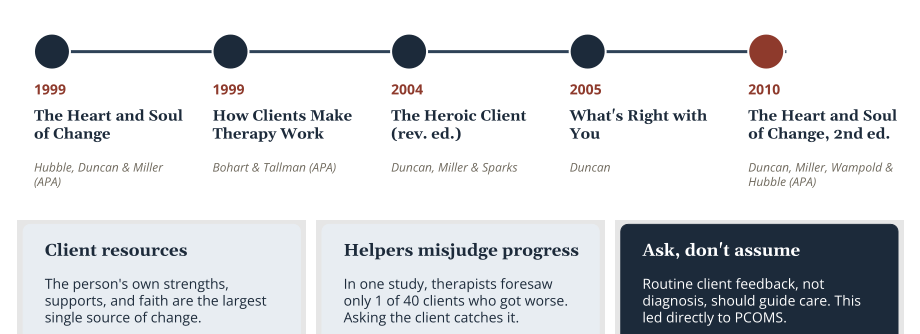
Duncan and Miller
The client is the engine of change
Fit
Explanations that fit a person's worldview work better
The contextual model explains how help works. The Model of the Person explains who the person is and what flourishing means. The two fit together, and the evidence says the fit matters.
Adapted to culture
Therapy adapted to clients' culture outperformed the same therapy unadapted (d = 0.32), and adapting the explanation of the problem was the active ingredient.
Benish, Quintana & Wampold (2011)
Adapted to faith
Across 97 studies, therapy adapted to clients' faith improved functioning more than secular therapy (g = 0.33) and added spiritual wellbeing.
Captari et al. (2018)
The Model supplies the explanation and the goals; PCOMS checks every session that the person accepts it and is improving. The Model of the Person.
Measures
Licensed PCOMS: the client's voice in every session
Outcome Rating Scale (ORS)
Everyone, at every level
How the person is doing individually, in close relationships, socially and overall
Relationship Rating Scale (RRS)
Non-licensed helpers
How the person rates the helping relationship with a Companion, listener, coach, spiritual guide or pastor
Session Rating Scale (SRS)
Licensed clinicians
How the person rates the therapy session: relationship, goals, approach and overall
Each takes about a minute. One shared record follows the person up and down the STEP levels. The measures are used under license from Dr. Barry Duncan through Better Outcomes Now, were developed by Duncan and Miller from the Heart and Soul of Change research, and were listed on SAMHSA's National Registry of Evidence-based Programs and Practices in 2013.
The evidence behind PCOMS
Anker, Duncan & Sparks (2009), Journal of Consulting and Clinical Psychology
Randomized trial, 205 couples in Norway: nearly four times the rate of clinically significant change, and 18% vs. 34% separated at follow-up.
Reese, Norsworthy & Rowlands (2009), Psychotherapy
Trials in counseling settings: clients of trainees using feedback improved more and faster.
Lambert, Whipple & Kleinstäuber (2018), Psychotherapy
Meta-analysis of 24 studies: feedback nearly doubled improvement rates for clients who were not on track.
Østergård, Randa & Hougaard (2020), Psychotherapy Research
PCOMS meta-analysis: small overall effect, none in psychiatric settings. Findings are debated (Duncan & Sparks, 2020).
Our position: PCOMS has a solid research base, and we will add to it by reporting our own results across every STEP level.
Training
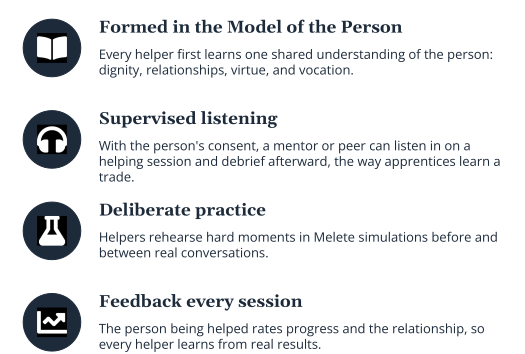
Training on the job, with more than one set of ears
Experience alone does not make helpers better (Goldberg et al., 2016). Deliberate practice does (Chow, Miller et al., 2015). Routine client feedback improves outcomes, most for people who are not improving (Lambert et al., 2018).
See the model this research produces
Four steps, one record, a response within eight hours.