For parishes, campuses and community groups
Keep your name, your leaders and your rhythm. Add trained presence and a next step.
Presence+ does not ask you to start a ministry. It works inside the ones you already run. A parish or campus can do five things here: bring our courses to your people, publish your own, run your community's needs through Midst, spread helping through Raphael, and tie in licensed professionals through Mindspirit. The Community tier is sponsored.

01
Bring our courses to your church community.
Short formation from Divine Mercy University faculty, about an hour each, in the Model of the Person. Run them for your Companions, ministers and staff. Each person enrolls with a MindSpirit account, or your community runs them for a whole team through Emmaus.

Accompanying Men: Principles of Effective Spiritual Direction
Five proven principles for reaching men who think they don't have time for God.
Most men do not seek spiritual direction — and many who try it once never return. Fr. John Hopkins has accompanied hundreds of men across decades of pastoral work. In this engaging interview, he shares five principles that transform resistant, skeptical men into committed directees: positivity, challenge, concrete homework, deep questioning, and loving accountability. Whether you are a spiritual director, priest, deacon, or Catholic counselor, this course will change how you see the men you serve.
45 min · 1 lesson · Intermediate
With Fr. John Hopkins, LC

Guarding the Gift: Pornography, Gender Differences, and the Restoration of Marital Intimacy
A Catholic Clinical and Pastoral Perspective
What drives pornography use — really? This 1-hour NBCC CE course brings together clinical psychologists and spiritual directors to examine the emotional and relational roots of pornography use, with close attention to how those roots look different in men and women. Grounded in Catholic anthropology and current clinical practice, Guarding the Gift gives counselors and pastoral ministers a framework for accompanying individuals and couples with compassion, precision, and hope.
1 hr · 1 lesson · Advanced
With Harvey Payne, Psy.D., Lisa Klewicki, MAT, Ph.D., Julia Hogan, LCPC and Dr. John Hopkins

What Your Child Isn't Saying: Recognizing Childhood Anxiety, Bullying, and Digital Risk — A Clinical and Catholic Formation Course
Recognizing Childhood Anxiety, Bullying, and Digital Risk — A Clinical and Catholic Formation Course
Ian Masson, LPC, NCC, RPT, Director of the IPS Center at Divine Mercy University, presents clinical warning signs of childhood anxiety across developmental stages — including bullying, digital safety risks, and the role of family relationship and faith community as protective factors.
45 min · 1 lesson · Beginner
With Ian Masson

Made for Love: An Introduction to John Paul II's Theology of the Body for Helping Professionals
The foundation every Catholic counselor and pastoral minister needs to understand the whole person.
The Theology of the Body is not primarily a document about marriage. It is a comprehensive answer to: Who am I? and How do I live? It is rooted in the original dignity of the human body, the wounds of the fall, and the breathtaking destiny that Christ opens for every human person.
45 min · 1 lesson · Beginner
With Bill Donohue, Ph.D.
What we have built
For parishes and campuses, we have built 85 courses.
formation a community can run for its own people without a counseling department. There are courses for the priests, deacons and staff who accompany parishioners every week: effective spiritual direction, reaching busy and skeptical men, listening where God is already at work, and the everyday benefits of having someone to walk with. There is prayer formation a parish can offer in Lent or a men's group can take together, on mental prayer, hearing God's voice, Scripture and the three voices in discernment. There is marriage material, from preparing couples for the wedding night to restoring intimacy after pornography, and parenting material on childhood anxiety, bullying and grief. There are courses for the hard pastoral conversations: post-abortion healing through Project Rachel, same-sex attraction with truth and mercy, and the compassion fatigue that quietly empties ministers. And there is leadership formation for the people who run all of it. Everything is about an hour, taught by Divine Mercy University faculty, and can be run for a whole team through Emmaus with the outcomes measured.
By topic
Courses a parish or campus starts with, sorted.
Formation in the Model first, then spiritual direction, pastoral care, marriage, and children.
Spiritual direction

Three Voices, One Relationship: Discerning God, the Enemy, and the World
Stop interrogating every spiritual experience. Learn to read where a soul is actually moving — and to trust the God who is already at work in it.
Was that God — or was that just me? It's the question every directee eventually asks, and that can leave even seasoned directors reaching for an answer quickly.
45 min · 1 lesson · Intermediate
With Fr. Robert Presutti, LC and Fr. John Pietropaoli, LC
Three Voices, One Relationship: Discerning God, the Enemy, and the World
Was that God — or was that just me? It's the question every directee eventually asks, and that can leave even seasoned directors reaching for an answer quickly.
45 min · 1 lesson · Intermediate
With Fr. Robert Presutti, LC and Fr. John Pietropaoli, LC
Accompanying Men: Principles of Effective Spiritual Direction
Five proven principles for reaching men who think they don't have time for God.
Most men do not seek spiritual direction — and many who try it once never return. Fr. John Hopkins has accompanied hundreds of men across decades of pastoral work. In this engaging interview, he shares five principles that transform resistant, skeptical men into committed directees: positivity, challenge, concrete homework, deep questioning, and loving accountability. Whether you are a spiritual director, priest, deacon, or Catholic counselor, this course will change how you see the men you serve.
45 min · 1 lesson · Intermediate
With Fr. John Hopkins, LC
Prayer and discernment
Prayer that has gone dry, decisions, and hearing God.

When God Feels Absent: The Relational Art of Accompanying Spiritual Dryness
Presence is the intervention. Learn how to offer it.
Sooner or later, everyone you accompany hits a wall in prayer, and they arrive frightened that their faith is going with it. In one real 17-minute session, watch a spiritual director accompany a devout woman through that exact crisis without reassuring, fixing, or explaining it away. Learn the relational skills — reflective listening, validation, working with a person's own images — that carry someone through spiritual dryness.
1 hr · 1 lesson · Intermediate

When Fear Becomes Faith: Fr. Groeschel on Childhood Wounds, Trust, and Prophetic Living
Your fear has roots. Your faith can have wings.
What if your difficulty trusting God began long before you understood what trust was? Fr. Benedict Groeschel — one of the most beloved Catholic psychologists of our time — explores the childhood roots of fear, the saints who found their way through, and what it looks like to arrive at genuine surrender. Three lessons. Real tradition.
2 hr 30 min · 4 lessons · Intermediate
With Fr. Benedict Groeschel, C.F.R.

Your Wound Is Not Your Obstacle: St. Thérèse on Grace, Holiness, and the Little Way
You don't have to be healed to be holy.
Many of us carry the quiet assumption that we need to heal — emotionally, psychologically, spiritually — before we can truly give, truly pray, truly grow. Thérèse of Lisieux never believed this. Fr. Marc Foley, OCD, shows us why she was right, and what her insight means for how we accompany ourselves and others.
1 hr · 1 lesson · Intermediate
With Marc Foley, O.C.D.
Marriage and couples
Intimacy, conflict, repair, and preparing for marriage.
Guarding the Gift: Pornography, Gender Differences, and the Restoration of Marital Intimacy
A Catholic Clinical and Pastoral Perspective
What drives pornography use — really? This 1-hour NBCC CE course brings together clinical psychologists and spiritual directors to examine the emotional and relational roots of pornography use, with close attention to how those roots look different in men and women. Grounded in Catholic anthropology and current clinical practice, Guarding the Gift gives counselors and pastoral ministers a framework for accompanying individuals and couples with compassion, precision, and hope.
1 hr · 1 lesson · Advanced
With Harvey Payne, Psy.D., Lisa Klewicki, MAT, Ph.D., Julia Hogan, LCPC and Dr. John Hopkins

Beautiful and Holy — Preparing Couples for the Wedding Night
Accompanying the Body, Heart, and Soul Toward Self-Giving Love
Help couples prepare for a wedding night — and a whole married life — that is genuinely beautiful and holy, without freezing when the intimate questions come.
1 hr · 1 lesson · Intermediate
With Lisa Klewicki, MAT, Ph.D. and Dr. John Hopkins
Guarding the Gift: Pornography, Gender Differences, and the Restoration of Marital Intimacy
What drives pornography use — really? This course brings together clinical psychologists and spiritual directors to examine the emotional and relational roots.
1 hr · 1 lesson · Advanced
With Harvey Payne, Psy.D., Lisa Klewicki, MAT, Ph.D., Julia Hogan, LCPC and Dr. John Hopkins
Children and parents
Anxiety, grief, screens, and the long game of being present.
What Your Child Isn't Saying: Recognizing Childhood Anxiety, Bullying, and Digital Risk — A Clinical and Catholic Formation Course
Recognizing Childhood Anxiety, Bullying, and Digital Risk — A Clinical and Catholic Formation Course
Ian Masson, LPC, NCC, RPT, Director of the IPS Center at Divine Mercy University, presents clinical warning signs of childhood anxiety across developmental stages — including bullying, digital safety risks, and the role of family relationship and faith community as protective factors.
45 min · 1 lesson · Beginner
With Ian Masson
What Your Child Isn't Saying: Recognizing Childhood Anxiety, Bullying, and Digital Risk — A Clinical and Catholic Formation Course
Clinical Indicators of Childhood Anxiety, Bullying, and Digital Risk — through a Catholic anthropological lens
45 min · 1 lesson · Beginner
With Ian Masson

When Children Grieve: Helping Kids and Families Through the Death of a Loved One
Whether you sit with grieving families professionally or you are simply the adult a child turns to, this course gives you what to say and what to do.
When someone dies, children take in far more than the adults around them realize, and they grieve in ways that look nothing like adult grief.
1 hr 30 min · 1 lesson · Intermediate
With Paula Darcy and Khris Ford
Pastoral care and ministry
Made for Love: An Introduction to John Paul II's Theology of the Body for Helping Professionals
The foundation every Catholic counselor and pastoral minister needs to understand the whole person.
The Theology of the Body is not primarily a document about marriage. It is a comprehensive answer to: Who am I? and How do I live? It is rooted in the original dignity of the human body, the wounds of the fall, and the breathtaking destiny that Christ opens for every human person.
45 min · 1 lesson · Beginner
With Bill Donohue, Ph.D.

The Examined Leader: Character, Trust, and Christian Anthropology at Work
Leadership isn't a technique. It's a life.
Forty years. Remarkable results. One Catholic CEO's conversation on character, trust, and what Christian anthropology actually looks like at work.
45 min · 1 lesson · Beginner
With Robert Luddy

Part of the Cure: How to Help Someone You Love Who Has PTSD
Loving someone with PTSD can leave you feeling helpless. You’re not. In about 40 minutes, two of the world’s leading trauma experts explain what PTSD really is and what you can do to help — in plain language, with no medical background needed. You are part of the cure.
45 min · 1 lesson · Beginner
With Frank Ochberg, MD & Angie Panos, Ph.D.
Leadership and the use of self

Failure Is Not an Option: Leadership, Decision-Making & Virtue Under Pressure
Leadership is what your character does when control runs out.
An asynchronous, six-lesson formation course that uses six scenes from the film Apollo 13 (1995) — set beside the real April 1970 mission — as a case study in how good decisions get made and good character is revealed when everything is on the line.
3 hrs · 8 lessons · Beginner

The First Person You Lead: Self-Awareness, Servant Leadership, and the Use of Self in the Helping Professions
The best leaders are not the ones with the most impressive résumé. They are the ones who can see themselves clearly.
1 hr · 1 lesson · Intermediate
With Fr. Charles Sikorsky, LC, J.D., J.C.L. and Dr. Tammy Tenaglia

More Than Qualified: Women in Leadership through the Lens of Catholic Psychology
Have you ever been invited into a leadership role and wondered: Why me? I'm not qualified for this. You are not alone — and you are almost certainly wrong.
45 min · 1 lesson · Beginner
With Dr. Tammy Tenaglia
02
Bring your own content to your community on Emmaus.
Emmaus is the only learning platform with Regular Outcomes measures and mentorship built into the LMS itself. Publish your parish's own formation, pair each learner with a mentor who can listen in with consent, and see whether the people taking it are getting better, not only whether they finished.
Regular Outcomes inside
Every course can carry the ORS and RRS, so formation is measured by the same record as care.
Mentorship inside
A mentor is part of the course: supervised listening with consent, a debrief, deliberate practice in Melete.
Your name on it
Your courses, your branding, your learners. Share them with the network or keep them to your community.
03
Use Midst to manage the mental health needs of your community.
Midst sits inside the ministries you already run. A need surfaces. A coordinator checks it and responds within eight hours. The person is matched with a helper at the right level, says after every conversation how it is going, and moves up or down by that feedback. Your community stays involved the whole way, and your leaders decide who may help, in what scope, and when to hand up.
“For where two or three are gathered together in my name, there am I in the midst of them.” Matthew 18:20
The Community tier is sponsored. Nothing is charged to a parish, campus or community group for the companion tools.
04
Spread the ability to help each other with Raphael.
Raphael is the app your Companions and staff help through. It holds the conversation, the one-minute measures after it, and the warm hand-off. It turns a parish's good will into capacity, one trained person at a time, under the leadership the community already has.
Invite
Friends, family and neighbors who already walk alongside are formed and equipped, not replaced.
Listen
Trained listeners and ministers take conversations in the app or in person, with the measures built in.
Step
When someone needs more, the next helper is already known inside Midst, and the record goes with the person.
05
Tie in licensed professionals.
Midst integrates with the Mindspirit practice-management system. The therapists, psychologists and credentialed coaches you refer to work in their own EHR, while the person's record and measures stay in the Presence+ data store, shared the way the person and your leadership decide. Referrals arrive warm. When therapy ends, the person steps down to someone who already knows them.
Self-sustaining by design
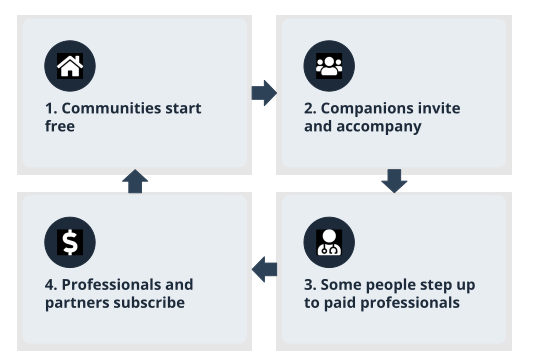
Communities start on a sponsored tier. Paid helpers and partners fund it.
Your data
Who decides what happens with the information
Three parties, each for their own part. That is the difference between the Presence+ data store and the free tools most ministries use today.
Most parishes run sign-ups, mailing lists and event forms through free online services. Free has a price: the service keeps a copy of the parish's people and sets its own policy for what it may do with them, agreed to in a click by whoever opened the account, and some of those companies exist to sell that data. Later the same parish worries about AI working through everyone's information, without noticing that it handed the information over in a sign-up form.
The Presence+ data store is held by True Presence, Inc., a 501(c)(3), and controlled by Divine Mercy University. Nothing in it is sold, mined or used to train anything. It is used for your ministry's purposes and no other.
The person
Decides how their own information is shared, with whom, and for how long. Nothing moves to a helper or a clinician without their say.
The helper
Decides what they record about a conversation and who may read it. A note stays on the relationship it was written on.
Your leadership
Decides how the ministry's information, its rosters, sign-ups, relationships and notes, is shared with other ministries, with applications and with the Network.
Give
A community's first tier costs it nothing because someone paid for it.
Presence+ is a program of True Presence, Inc., an Arizona 501(c)(3) with no profit motive. Parishes, campuses and community groups are never charged for the companion tools. Gifts and grants are what make that true. Every revenue stream except Mindspirit's practice-management subscriptions flows to the nonprofit, and every gift goes to formation, coordination, sponsored access and research.
A first cohort
Launches STEP in one parish, campus or community group: the coordinator's formation, the first Companions' courses, and the measures from the first conversation.
A coordinator
Pays for the person who checks a need within eight hours and matches it to the right helper, for a year, in a community that could not fund one.
Formation scholarships
Covers courses for helpers who cannot pay: deacons, campus ministers, listeners in rural parishes, people in recovery who now walk with the next one.
The evidence
Funds the independent evaluation that will say, either way, whether accompaniment through STEP improves outcomes.
True Presence, Inc. is recognized as tax-exempt under section 501(c)(3), and gifts are deductible to the extent the law allows. Every gift gets a written acknowledgment, and each year we will tell you what it paid for and what we learned.
Start a first cohort
We will show you what the first weeks look like for a parish, a campus or a community group, and tell you where the network stands today.