For organizations that work inside or alongside churches
Bring trained presence to every community you serve, without replacing any of them.
Dioceses, faith networks, universities, schools, counseling centers, ministries and civic organizations. Six things an organization can do, below: bring our courses to the communities you serve, publish your own, run their needs through Midst, spread helping through Raphael, connect your licensed professionals through Mindspirit, and scale it all as an implementing partner, under your own name if you want.

01
Bring our courses to the communities you serve.
Formation for the people who help and the people who lead them: leadership, the Model of the Person, scope, compassion fatigue, the research behind STEP. Run them across a diocese, a campus system or a network of ministries through Emmaus, with completion and outcomes visible to you.

Failure Is Not an Option: Leadership, Decision-Making & Virtue Under Pressure
Leadership is what your character does when control runs out.
An asynchronous, six-lesson formation course that uses six scenes from the film Apollo 13 (1995) — set beside the real April 1970 mission — as a case study in how good decisions get made and good character is revealed when everything is on the line.
3 hrs · 8 lessons · Beginner

The Examined Leader: Character, Trust, and Christian Anthropology at Work
Leadership isn't a technique. It's a life.
Forty years. Remarkable results. One Catholic CEO's conversation on character, trust, and what Christian anthropology actually looks like at work.
45 min · 1 lesson · Beginner
With Robert Luddy

When Fear Becomes Faith: Fr. Groeschel on Childhood Wounds, Trust, and Prophetic Living
Your fear has roots. Your faith can have wings.
What if your difficulty trusting God began long before you understood what trust was? Fr. Benedict Groeschel — one of the most beloved Catholic psychologists of our time — explores the childhood roots of fear, the saints who found their way through, and what it looks like to arrive at genuine surrender. Three lessons. Real tradition.
2 hr 30 min · 4 lessons · Intermediate
With Fr. Benedict Groeschel, C.F.R.

More Than Qualified: Women in Leadership through the Lens of Catholic Psychology
Have you ever been invited into a leadership role and wondered: Why me? I'm not qualified for this. You are not alone — and you are almost certainly wrong. In this 15-minute interview-based lesson, Dr. Tammy Tenaglia, Ph.D., shares what she discovered when she joined a Catholic foundation board surrounded by corporate executives: her distinctiveness was the point. Her psychological expertise was exactly what the room needed. Drawing on Catholic anthropology, the science of impostor syndrome, and the spiritual practice of daily self-examination, this lesson equips Catholic women to step into leadership from a place of clarity, confidence, and conviction.
45 min · 1 lesson · Beginner
With Dr. Tammy Tenaglia
What we have built
For dioceses, networks and institutions, we have built 58 courses.
two things. The first is leadership formation for the people who carry an organization: character and trust at work, decision-making under pressure through the Apollo 13 story, self-awareness and the use of self for those who lead helping professionals, and women in leadership through the lens of Catholic psychology. The second is shared formation in the Model of the Person that a whole staff, seminary cohort or counseling center can take together, so that a chancery, a campus ministry and a clinic are describing the same human being: the eleven premises, the call to flourish, and how the Model transforms clinical care. Beside those sit courses an organization will want to put in front of specific teams, on compassion fatigue, group facilitation, trauma care after disaster and co-occurring disorders. And the rest of the catalog, more than eighty courses, is available to the communities you serve through Emmaus, under your own name if you want it, with completion and outcomes visible to you.
By topic
Courses for leaders and teams, sorted.
Leadership first, then formation in the Model, ethics and scope, and pastoral care.
Leadership and the use of self
Failure Is Not an Option: Leadership, Decision-Making & Virtue Under Pressure
Leadership is what your character does when control runs out.
An asynchronous, six-lesson formation course that uses six scenes from the film Apollo 13 (1995) — set beside the real April 1970 mission — as a case study in how good decisions get made and good character is revealed when everything is on the line.
3 hrs · 8 lessons · Beginner
More Than Qualified: Women in Leadership through the Lens of Catholic Psychology
Have you ever been invited into a leadership role and wondered: Why me? I'm not qualified for this. You are not alone — and you are almost certainly wrong. In this 15-minute interview-based lesson, Dr. Tammy Tenaglia, Ph.D., shares what she discovered when she joined a Catholic foundation board surrounded by corporate executives: her distinctiveness was the point. Her psychological expertise was exactly what the room needed. Drawing on Catholic anthropology, the science of impostor syndrome, and the spiritual practice of daily self-examination, this lesson equips Catholic women to step into leadership from a place of clarity, confidence, and conviction.
45 min · 1 lesson · Beginner
With Dr. Tammy Tenaglia

The First Person You Lead: Self-Awareness, Servant Leadership, and the Use of Self in the Helping Professions
The best leaders are not the ones with the most impressive résumé. They are the ones who can see themselves clearly.
1 hr · 1 lesson · Intermediate
With Fr. Charles Sikorsky, LC, J.D., J.C.L. and Dr. Tammy Tenaglia
Formation in the Model

Treating the Whole Person — How the Catholic Christian Meta-Model Transforms Clinical Care
Clinical training gives you partial lenses: one for the inner life, another for behavior, the family, the brain. Each is true, but none is the whole person.
1 hr · 1 lesson · Intermediate
With Dr. William Nordling

You Are Mine: Accompanying Same-Sex Attraction with Truth and Mercy
A short formation course on accompanying people who experience same-sex attraction with compassion, truth, and respect. Grounded in Catholic teaching, Sacred Stories, and the Catholic Christian Meta-Model of the Person, it equips helping professionals to uphold both Church teaching and human dignity
1 hr · 1 lesson · Intermediate

The Dignity Beneath the Diagnosis: Understanding Clients Through the Catholic Christian Meta-Model of the Person
Every counselor carries a picture of the human person into the room, whether they name it or not. In one hour, this faith-integrated course helps you make it explicit and whole — so you can see a client’s dignity beneath the diagnosis.
1 hr · 1 lesson · Intermediate
With Craig Steven Titus, S.T.D., Ph.D. and Harvey Payne, Psy.D.
Group work

The Whole Person in the Group — Facilitation Through the Catholic Christian Meta-Model
What changes in a group when you see the whole person.
A group is more than a room where people work on their problems. In this panel, Dr. Harvey Payne, William Nordling, Gabriel Dy-Liacco, and Su Li Lee show how the Catholic Christian Meta-Model reframes group work as the formation of the whole person — through vocation, virtue, self-giving, and shared suffering — and what it asks of the leader who bears the group’s burden.
55 min · 1 lesson · Intermediate
With Harvey Payne, Psy.D., Dr. Su Li Lee, Dr. Gabriel S. Dy-Liacco and Dr. William Nordling

Goals That Move the Group: Setting Direction Across Group Therapy Models
How direction actually emerges in process and psychoeducational groups.
Goals matter in every group, but they are not set the same way in every group. In this conversation, Prof. Gabriel Dy-Liacco shows Dr. Harvey Payne how direction emerges in a psychodynamic process group — through honest expression, linking, and shared themes — and how that differs from the direct goal-setting of a psychoeducational group. You will leave able to read a group’s design and set direction accordingly.
1 hr · 1 lesson · Intermediate
With Dr. Gabriel S. Dy-Liacco and Harvey Payne, Psy.D.

When Children Grieve: Helping Kids and Families Through the Death of a Loved One
Whether you sit with grieving families professionally or you are simply the adult a child turns to, this course gives you what to say and what to do.
When someone dies, children take in far more than the adults around them realize, and they grieve in ways that look nothing like adult grief.
1 hr 30 min · 1 lesson · Intermediate
With Paula Darcy and Khris Ford
Trauma and disorders

Two Diagnoses, One Person: Treating Co-occurring Disorders
Two diagnoses. One person. One hour.
Most clients don’t arrive with one clean diagnosis. Dr. Kathie Erwin, a licensed counselor who has practiced and taught for nearly twenty years, walks you through what actually happens when two diagnoses live in one person: how to use the DSM-5 to aim, why trauma and culture and a client’s spiritual strengths belong in the plan from day one, and how a whole-person approach turns five separate problem lists into one coherent plan.
1 hr · 1 lesson · Intermediate
With Dr. Kathie Erwin, Ed. D

Guarding the Gift: Pornography, Gender Differences, and the Restoration of Marital Intimacy
A Catholic Clinical and Pastoral Perspective
What drives pornography use — really? This 1-hour NBCC CE course brings together clinical psychologists and spiritual directors to examine the emotional and relational roots of pornography use, with close attention to how those roots look different in men and women. Grounded in Catholic anthropology and current clinical practice, Guarding the Gift gives counselors and pastoral ministers a framework for accompanying individuals and couples with compassion, precision, and hope.
1 hr · 1 lesson · Advanced
With Harvey Payne, Psy.D., Lisa Klewicki, MAT, Ph.D., Julia Hogan, LCPC and Dr. John Hopkins

What Your Child Isn't Saying: Recognizing Childhood Anxiety, Bullying, and Digital Risk — A Clinical and Catholic Formation Course
Recognizing Childhood Anxiety, Bullying, and Digital Risk — A Clinical and Catholic Formation Course
Ian Masson, LPC, NCC, RPT, Director of the IPS Center at Divine Mercy University, presents clinical warning signs of childhood anxiety across developmental stages — including bullying, digital safety risks, and the role of family relationship and faith community as protective factors.
45 min · 1 lesson · Beginner
With Ian Masson
02
Bring your own content to your people on Emmaus.
Emmaus is the only learning platform with Regular Outcomes measures and mentorship built into the LMS itself. Publish your organization's formation, pair each learner with a mentor who can listen in with consent, and see whether the people taking it are getting better, not only whether they finished. White-label it under your name if you want.
Regular Outcomes inside
Every course can carry the ORS and RRS, so formation is measured by the same record as care.
Mentorship inside
A mentor is part of the course: supervised listening with consent, debrief, deliberate practice in Melete.
Your name, your network
Your courses and branding, shared with every community you serve or with the whole network.
03
Use Midst to manage the mental health needs of the communities you serve.
Midst coordinates each community: a need surfaces inside a ministry it already runs, a coordinator verifies it and responds within eight hours, the person is matched at the right level, and the person's own feedback moves care up or down. For an organization, Midst is also the view across communities: who is being helped, by whom, and whether it is working.
“For where two or three are gathered together in my name, there am I in the midst of them.” Matthew 18:20
Communities start free. Nothing is charged to a parish, campus or community group for the companion tools.
04
Spread the ability to help each other with Raphael.
Raphael is the app Level 1 and 2 helpers help through: the conversation, the one-minute measures, the warm hand-off. Across a diocese or a school system it is how good will becomes capacity, one formed person at a time.
Invite
The people who already walk alongside are formed and equipped, not replaced.
Listen
Trained listeners, ministers and staff take conversations with the measures built in.
Step
When someone needs more, the next helper is already known inside Midst, and the record follows the person.
05
Connect your licensed professionals.
Midst integrates with the Mindspirit practice-management system. A counseling center, a clinic or a network of therapists works in its own EHR while the person's record and measures stay in one place with the community that referred them. Referrals arrive warm, and nobody is discharged into nothing.
06
Scale it as an implementing partner, white label, or through the API.
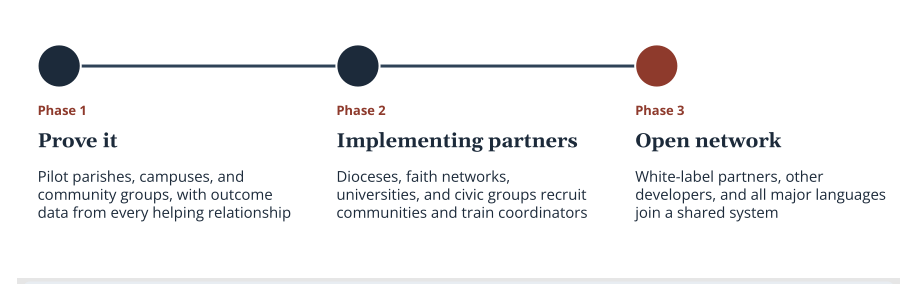
Implementing partners recruit communities and train coordinators while we form helpers and run the suite; that is how STEP goes from dozens of communities to thousands, on the model CarePortal proved for verified need. White-label partners run the suite under their own name. API partners keep the systems they have and connect them.
Evidence
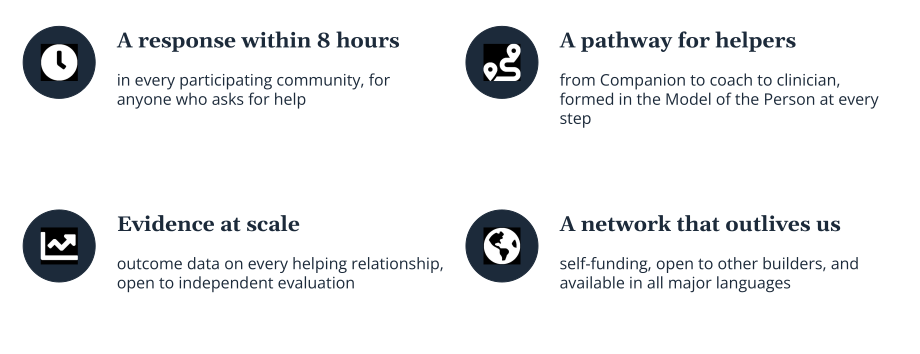
Outcome data on every helping relationship, open to independent evaluation.
STEP measures every relationship at every level with licensed PCOMS instruments, and we are looking for an outside research partner to test whether it works, with funders willing to pay for the answer either way.
Partner with us
Tell us who you serve and how. We will be plain about where the network is today and what an implementing partner, a white label or an API connection would involve.