The model
STEP: the right help, at the right time, with Christ in the midst.
Where two or three are gathered in my name, there am I in the midst of them. The unit of care in STEP is two or three people. Most of the time that is a person and a friend. Sometimes it is a person and a trained listener, a coach, or a clinician. The model is the set of steps between them, and the rule that the person's own feedback decides when to move.
What STEP means
Four words, each a commitment
S
Support
Help begins with the person's strengths and the people already around them, not with a diagnosis.
T
Through
Care is delivered through a trained person in a real relationship, not through a program or an app alone.
E
Efficient
The right level of help at the right time. Most people are served well by trained helpers; clinicians are kept for those who need them.
P
Presence
Being truly present to the whole person, the heart of accompaniment, and measured session by session.
STEP builds on stepped care, an established health-services model in which people start with the least intensive help that works and step up only as needed. In STEP, the person's own feedback decides when to step up, and the community stays involved at every level.
The four levels
Who stands on each step
Level 1 · lay · unpaid
Companions
Friends, family and neighbors who invite and walk alongside; Active Listeners, Change Partners, accompaniment ministers and spiritual guides, trained and unpaid
Level 2 · staff
Professionals
Counselors, social workers, ministers and deacons serving in their professional roles
Level 3 · hourly
Credentialed helpers
Coaches and spiritual guides with a recognized credential who bill by the hour
Level 4 · licensed
Licensed caregivers
Licensed clinicians providing therapy, psychiatry and other clinical care
STEP always has at least four steps. A community can add steps of its own. Every participating community commits to a response within eight hours for anyone who asks for help, at whatever step is right.
Movement
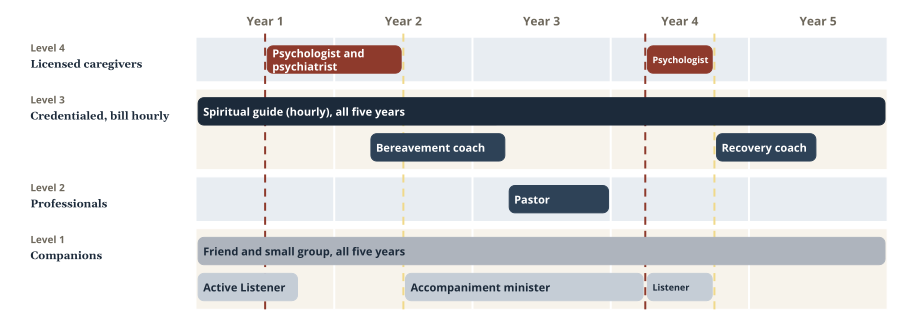
One person's five years in STEP
Movement is two-way and concurrent. A person may see a coach, a listener and a psychiatrist in the same season, and step back down after a series of sessions instead of being discharged.
How a need moves
Surface, verify, match, measure, step

The measures are the hinge. The Outcome Rating Scale is taken by everyone at every level; the Relationship Rating Scale by people helped by non-licensed helpers; the Session Rating Scale by clients of licensed clinicians. Each takes about a minute. One shared record follows the person up and down. Where the measures come from.
Inside existing ministries
STEP does not replace a ministry. It works inside each one.
A bereavement group, a men's breakfast, a campus Bible study, a parish's St. Vincent de Paul conference: each is already a way of gathering two or three. STEP respects each ministry's goals and way of working and adds three things.
Trained people
The helpers in the ministry are formed in the Model of the Person and in when to refer, through Emmaus.
A next step that already exists
When one relationship is not enough, Midst already knows who the next helper is, and the referral arrives warm.
A way to know it is working
The person rates progress and the relationship every time. The ministry sees what it is doing for people, in numbers it can share.
See STEP in practice
Seven short stories of people who started at different steps, and where they went.